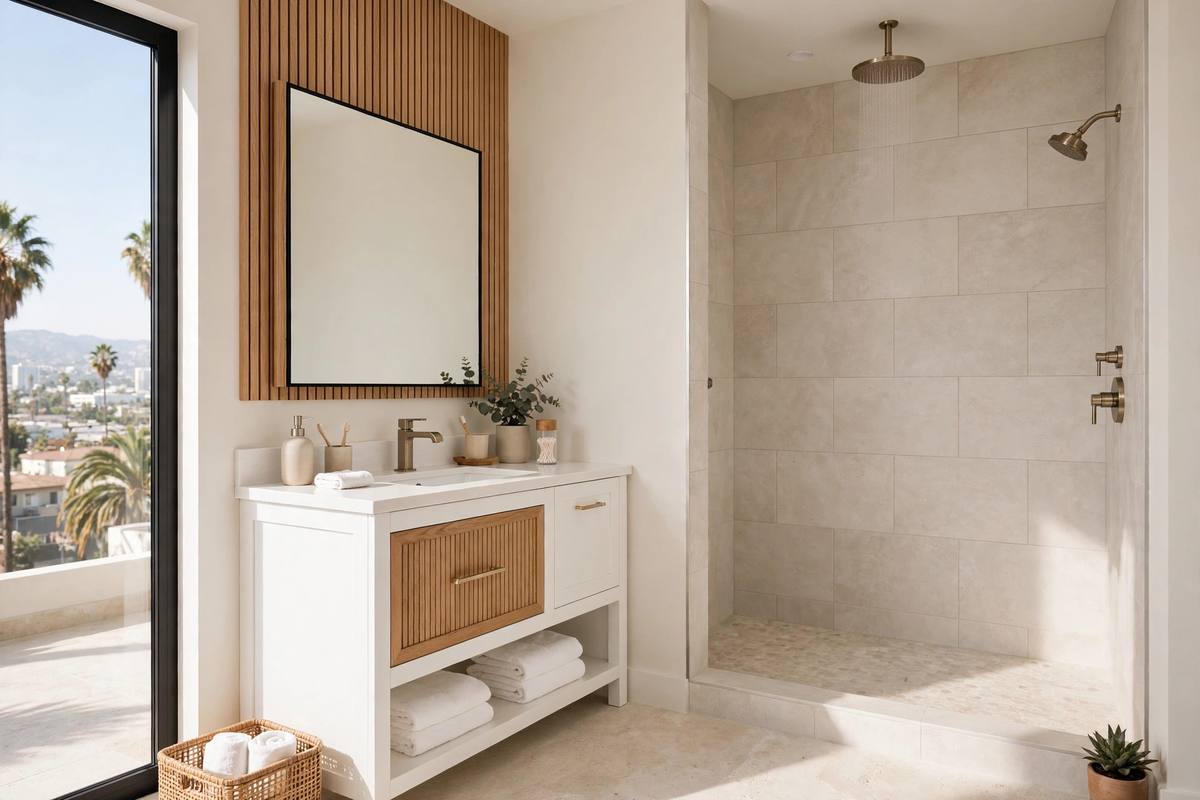
Start with the air, not the stain. A bathroom that fogs up and stays damp after a shower is telling you the fan is undersized, blocked, disconnected, or switched off too soon. In Los Angeles homes, the usual culprits are a fan venting into the attic or a wall cavity instead of outdoors, a crushed or disconnected duct, a fan clogged with dust, or a fan on the same switch as the light so it stops the moment someone leaves the room.
Diagnose the fan first
- Hold tissue to the grille. With the fan running, tissue should pull firmly toward the grille. Weak pull points to a clogged grille, a blocked duct, or a failing motor.
- Trace the duct. Bathroom exhaust must be ducted to the exterior, not into an attic, crawl space, or wall cavity. Dumping moist air into an attic trades wall mold for roof and framing moisture.
- Check the run time. Moisture lingers after the shower ends. A fan that stops with the light often stops before the room is dry. A timer or humidity-sensing control, where the wiring allows, keeps the fan running until humidity falls.
- Look for the moisture source. A leaking shower valve, a failed grout line, or a tub surround that was never properly waterproofed will keep feeding mold even with a good fan. Ventilation manages humidity; it does not repair a leak.
The three fixes that stop the cycle
First, clean and service what you have: switch off the breaker, remove the grille, vacuum dust from the fan housing and blades, and check that the damper opens freely. Second, correct the duct: replace crushed flex duct with a smooth, properly supported run to an exterior vent cap, and seal joints so moist air cannot leak into the cavity. Third, if the fan still cannot clear the room, replace it with a correctly sized unit for the room and duct length, and put it on a control that runs it long enough to dry the room. Guides cite quiet, humidity-controlled fans as the current Title 24 direction for bathroom ventilation in California remodels, so treat fan selection as a code-aware choice, not just a noise choice.
Cleaning the mold, then preventing its return
Clean small surface mold with a household cleaner made for the surface, ventilate the room while you work, and dry the wall fully before repainting. Do not paint over active mold and do not caulk over a wet joint and call it sealed. Repaint with a bathroom-suitable paint only after the fan and duct are corrected, the wall is dry, and any leak is repaired. If mold covers a large area, sits inside a wall cavity, or follows a plumbing leak, that is a repair job first and a cleaning job second.
The same waterproofing logic matters when a bathroom is remodelled rather than just dried out: the membrane and substrate behind the tile decide whether the room lasts. See our bathroom remodeling page and our tile installation page, and for a small-space example, our guide to updating a Hollywood bathroom without a full remodel in this blog.
Frequently Asked Questions
Why does bathroom mold keep coming back after I clean it?
Because cleaning removes the visible growth but not the moisture that feeds it. Until the fan moves enough air, runs long enough, and vents outdoors, humidity stays high and mold returns.
Can my bathroom fan vent into the attic?
No. Bathroom exhaust should be ducted to the exterior. Venting into an attic or wall cavity moves the moisture problem to framing and insulation instead of removing it.
How long should the fan run after a shower?
Until the room is dry, not just until the mirror clears. A timer or humidity-sensing control keeps the fan running after the light is switched off, which is the point most short-run fans fail.
When is mold a repair problem rather than a cleaning problem?
When it follows a leak, covers a large area, or sits inside a wall cavity. Fix the leak and the wet substrate first, then clean and dry the surface.
Get help with renovations in Los Angeles
If you are planning a bathroom ventilation repair in the City of Los Angeles, start with a conversation about scope, permits, and sequence before you commit to finishes or a start date.
Call Radiant Renovations Co. at +1 (424) 337-6597. The business is open 24 hours, 7 days a week, and is located at 352 W Martin Luther King Jr Blvd, Los Angeles, CA 90037.