Assessment and board selection
Damage, framing, moisture and existing texture are checked, and board type is chosen by room — moisture-appropriate board for wet areas, standard board for living areas.
Drywall is the surface every other finish depends on: paint, tile, cabinets and trim all read against it. Hung, taped and finished well, it disappears; rushed, it shows every seam under Los Angeles sunlight. This page explains what drywall installation and repair involves, including texture matching in older homes.
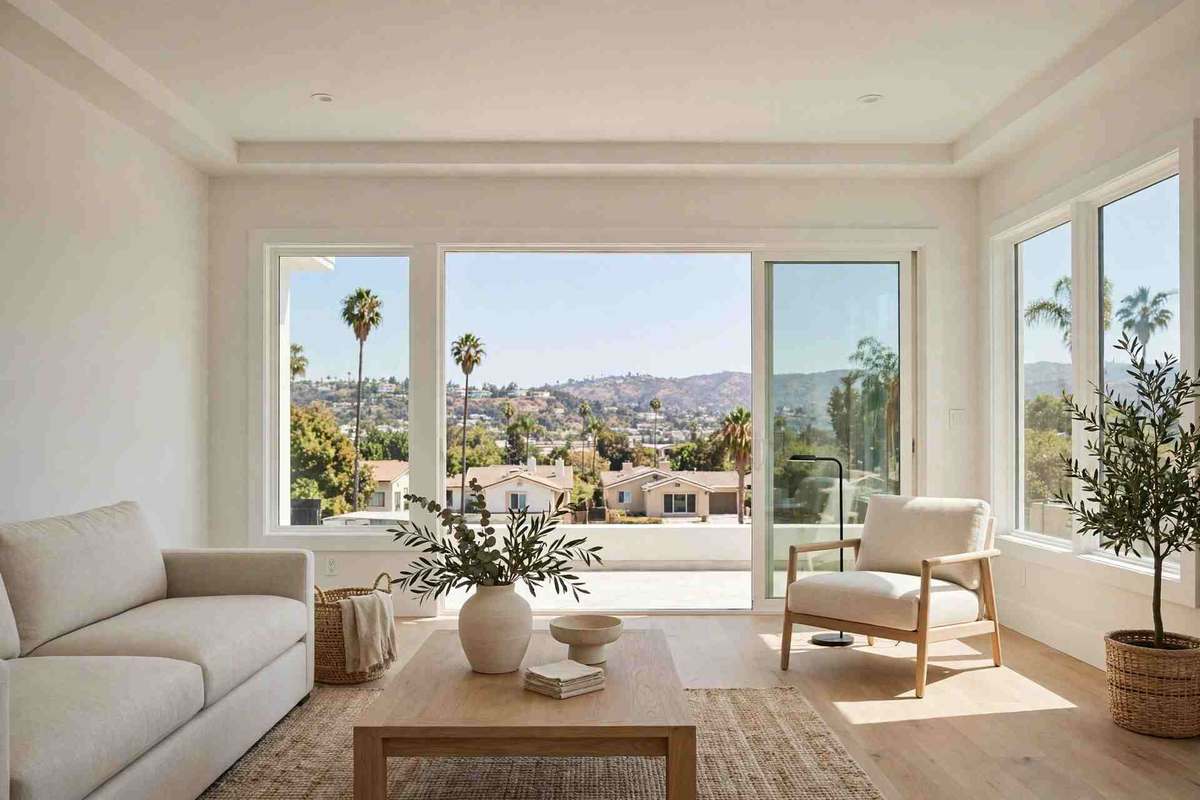
Drywall work hangs gypsum boards on framing, tapes and coats the seams in stages, sands to a flat finish, and matches the existing wall texture — smooth, orange peel, knockdown or skip trowel — so repairs blend rather than announce themselves. In older Los Angeles homes, plaster walls, lath and prior patches complicate the scope, and the board type matters: moisture-appropriate board in bathrooms, fire-rated board where code requires it, standard board elsewhere.
Cost varies by area, board type, texture matching and whether the scope is a patch or a full-room hang; pricing is set out in a written estimate after the site visit. The scope below is what a written estimate should itemise instead.
Drywall scopes range from a small patch to a full-room hang after a remodel. The stages below cover both, with texture matching as its own stage.
Damage, framing, moisture and existing texture are checked, and board type is chosen by room — moisture-appropriate board for wet areas, standard board for living areas.
Boards are hung tight to framing with screws set to the right depth, seams staggered, and openings cut cleanly for outlets, windows and doors.
Seams are taped and coated in stages — embed, fill and finish coats — with drying time between coats, so seams do not crack or show.
The existing texture is matched by type and density, tested in an inconspicuous area before the full wall is textured.
The finished surface is sanded smooth, cleaned, and primed so paint goes on evenly and seams stay invisible.
Damage, framing, moisture and texture are checked, and the scope — patch, partial hang or full hang — is written down.
Boards are hung, screwed and cut for openings, with seams staggered and edges supported by framing.
Seams are taped and coated in stages with drying time between coats, rather than filled in a single heavy coat that cracks.
Texture is matched to existing walls, the surface is sanded, and primer goes on before paint.
Walls are checked under raking light against the written scope, with any visible seam or texture mismatch corrected before handover.
Damage, framing, moisture and texture are checked, and the scope — patch, partial hang or full hang — is written down.
Ceiling boards are hung safely with a lift, and boards are cut cleanly for outlets and openings so patches fit tight.
Seams are coated in thin, even stages with the right knife widths, building a flat joint rather than a ridge.
Texture is sprayed and knocked down or left to match the existing wall type and density.
Sanding is checked under raking light, since that is the light the finished wall will actually be seen in.
Sanding dust is contained at the work zone, so the rest of the home stays clean while walls are finished.
Koreatown drywall work is often apartment and condo repair: unit-turn patches, ceiling repairs and texture matching in pre-1978 buildings, where plaster, prior patches and building rules shape the scope.
Van Nuys drywall scopes are often full-room hangs after a remodel or addition, with new boards meeting older plaster at doorways and ceilings — the joints where texture matching matters most.
Where this work fits in Los Angeles: Sherman Oaks · Van Nuys · Koreatown · Hollywood · Reseda · Panorama City.
Drywall failures show up as cracks, seams and texture mismatches. These are the problems to scope for.
Ask a pro →A crack that returns after patching usually means framing movement, moisture or a seam that was filled rather than taped. The cause is fixed, not just the crack.
Seams coated in one heavy coat or sanded unevenly show under raking light. Staged coating and light checks prevent it.
A patch textured with the wrong type or density stands out across the room. Texture is tested before the full wall is sprayed.
Board damaged by a leak must be replaced, not painted over, and the leak source fixed first or the new board fails the same way.
Radiant Renovations Co. holds a 4.8-star aggregate rating. No review count is published here, and no individual review quotations are shown on this page — full review text is shown on Google.
Drywall is gypsum board hung on framing; plaster is a wet-applied coating over lath. Older Los Angeles homes often have plaster, and repairs must match the existing system and texture rather than assume board throughout.
Often yes, if seams are taped and coated in stages and texture is matched to the existing wall. Large patches and texture mismatches are where invisibility fails, so both are scoped up front.
Drywall repair alone, with no structural, plumbing, gas or electrical change, is generally cosmetic work. If the scope opens walls for systems work or changes structure, the permit path changes.
Coating stages need drying time between coats, and texture and sanding add further stages. A patch can take days across coats, and a full room longer — the scope should show stages, not just a single visit.
Call (424) 337-6597 to talk through your drywall: patch or full hang, texture matching, and what the walls need before paint. Radiant Renovations Co. is open 24 hours, 7 days a week.
Get a Free Quote (424) 337-6597 →Call (424) 337-6597 to talk through your project. Radiant Renovations Co. is open 24 hours, 7 days a week. Tell us what you want to change and we will talk through what it takes, including the permit path for the scope.