Assessment and repairs
Boards are checked for thickness, cupping, gaps, stains and damage. Damaged boards are replaced and loose boards are secured before sanding starts.
Refinishing keeps the floor a house already has: original hardwood, sanded back, stained if desired, and sealed for another generation of use. It is the right scope where boards are sound and thick enough to sand — and the wrong scope where boards are too thin, damaged or cupped beyond sanding. This page explains how that call is made.
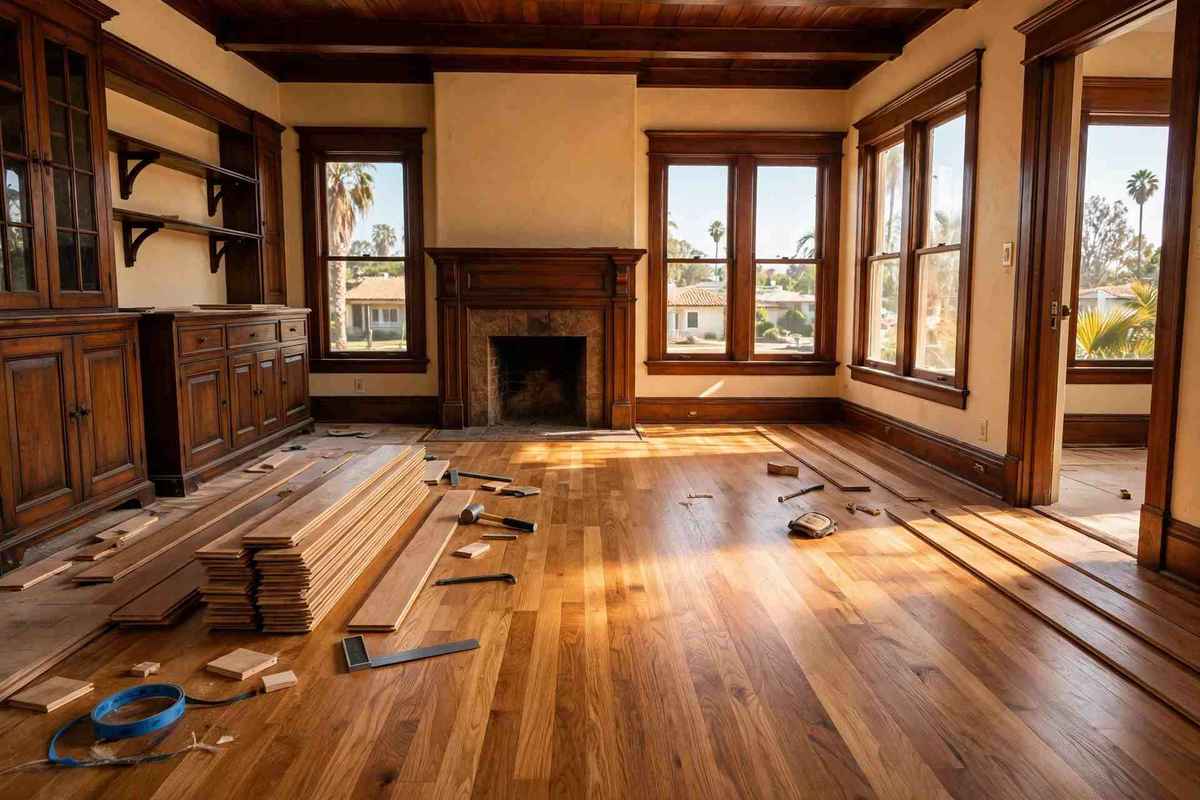
Refinishing sands the existing hardwood floor through progressively finer grits, repairs or replaces damaged boards, fills gaps where appropriate, then applies stain and a protective finish. The assessment comes first: solid hardwood can usually be sanded several times, while thin engineered veneers may only tolerate a light sand or none at all, and that distinction decides whether refinishing or new flooring is the honest scope.
Cost varies by floor area, board condition, stain and finish choice; pricing is set out in a written estimate after the site visit. The scope below is what a written estimate should itemise instead: sanding stages, repairs, stain, finish coats and drying time.
A refinishing scope covers the stages below. A recoat — a fresh finish layer without full sanding — is a smaller scope for floors whose finish is worn but whose wood is sound.
Boards are checked for thickness, cupping, gaps, stains and damage. Damaged boards are replaced and loose boards are secured before sanding starts.
The floor is sanded drum, edge and detail in progressively finer grits, removing the old finish and levelling the surface without gouging.
Gaps are filled where appropriate, the floor is cleaned and tacked, and stain samples are tested on the actual floor before full application.
Stain is applied evenly if a colour change is wanted, then protective finish coats are built up, with drying time respected between coats.
Baseboards and transitions are finished or touched up after the floor, so edges read clean against the new finish.
Board type, thickness, condition and prior finishes are checked, and the scope — full sand or recoat — is set from what the floor can take.
Furniture and rugs move out, damaged boards are repaired, and the work zone is sealed from the rest of the home for dust control.
Progressive-grit sanding removes the old finish and levels the floor, with edges and corners finished by hand tools.
Stain is applied if wanted, then finish coats are built up with drying time between coats and a final check for dust and lap marks.
The floor cures before furniture returns, and the finished floor is walked against the written scope.
Board type, thickness, condition and prior finishes are checked, and the scope — full sand or recoat — is set from what the floor can take.
Different sanders cover open floors, edges and corners, so the whole floor is sanded evenly rather than patched in places.
Sanding dust is contained at the machine and at the work-zone boundary, so the rest of the home stays clean.
Boards are checked for moisture and movement before sanding, since a floor that is still moving will not hold a new finish.
Stain is tested on the actual floor in an inconspicuous area, because the same stain reads differently on different wood and light.
Applicators matched to the finish type lay even coats without lap marks, bubbles or dust inclusions.
Silver Lake 1920s bungalows often hide original hardwood under carpet — sound boards that refinish beautifully once carpet, pad and staples are removed and the floor is assessed board by board.
Highland Park Craftsman homes commonly have original hardwood with period character: narrow boards, varied tones and wear at entries. Refinishing preserves that character where boards are thick enough to sand.
Where this work fits in Los Angeles: Silver Lake · Los Feliz · Highland Park · Eagle Rock · Echo Park · Mount Washington.
Refinishing fails when the floor is sanded before it is assessed. These are the problems to check first.
Ask a pro →Thin engineered veneers cannot take a full sand. Sanding through the veneer ruins the floor, so thickness is measured before sanding starts.
Boards cupped by moisture will not sand flat and may need replacement or drying time first. Sanding a wet floor wastes the finish.
Deep stains may not sand out fully. Stain choice and board replacement are discussed before sanding, not after the stain goes on.
A finish applied over dust or in uneven coats shows every flaw in raking light. Containment, drying time and even application prevent it.
Radiant Renovations Co. holds a 4.8-star aggregate rating. No review count is published here, and no individual review quotations are shown on this page — full review text is shown on Google.
It depends on board thickness and condition. Solid hardwood can usually be sanded several times; thin engineered veneers may only allow a light sand or a recoat. An assessment of the actual floor decides it.
Refinishing sands to bare wood and rebuilds stain and finish. Recoating adds a fresh finish layer over a sound existing finish without full sanding — a smaller scope for floors whose wood is fine but whose finish is worn.
Finish coats need drying time between coats and curing time before furniture returns. The written scope should state both, since rushing cure time damages the new finish.
Refinishing alone, with no structural, plumbing, gas or electrical change, is generally cosmetic work. If the scope opens walls or changes systems, the permit path changes.
Call (424) 337-6597 to talk through your hardwood floors: whether they can be refinished, what condition the boards are in, and what finish suits the rooms. Radiant Renovations Co. is open 24 hours, 7 days a week.
Get Free Quote (424) 337-6597 →Call (424) 337-6597 to talk through your project. Radiant Renovations Co. is open 24 hours, 7 days a week. Tell us what you want to change and we will talk through what it takes, including the permit path for the scope.